

Modern payment environments are built on speed and convenience, but attackers move even faster. A well-designed POS security architecture is the difference between a routine transaction day and a business-ending incident.
In retail, restaurants, service counters, and mobile checkout, the point of sale is where payment data, employee access, and customer trust intersect. That’s why POS security architecture must be engineered as a complete system—not a collection of add-on tools.
At a practical level, POS systems face three constant pressures. First, payment data is highly monetizable, which means criminals continually target swipe, dip, tap, and card-not-present workflows.
Second, POS environments are operationally messy: staff turnover, shared lanes, busy shifts, temporary managers, and multiple vendors supporting devices and software.
Third, compliance expectations keep tightening, and security failures now trigger more than chargebacks—they can cause contractual termination, forensic costs, notification obligations, civil claims, and severe brand damage.
A credible POS security architecture focuses on reducing the value of stolen data (through encryption and tokenization) and reducing the chance of theft (through access controls, segmentation, monitoring, and secure operations).
When done right, you can still run fast lanes and frictionless checkout while dramatically lowering breach risk. This guide breaks down encryption, tokenization, and access controls in depth, then ties them into a future-ready POS security architecture you can actually operate in the real world.
Building a Threat-Driven POS Security Architecture

A strong POS security architecture starts with a clear picture of what can go wrong. Too many organizations buy security products first and define threats later.
That’s backwards. POS environments are commonly attacked through malware on endpoints, weak remote access, misconfigured networks, vendor compromise, and credential theft. The most costly incidents often begin with something mundane: a reused password, a shared admin account, an unpatched device, or a third-party support tool left exposed.
Attackers typically pursue one of two goals. The first is payment data theft, including track data from magnetic stripe fallback, PAN exposure in memory, or card data leaked through insecure integrations.
The second is business disruption, like ransomware that halts sales during peak hours. A threat-driven POS security architecture treats both as first-class risks. Encryption and tokenization reduce the impact of data theft, while access controls and segmentation reduce the probability of initial compromise and lateral movement.
From an operational standpoint, threat modeling should match your deployment reality: countertop terminals, all-in-one POS registers, tablets with card readers, self-checkout kiosks, and back-office servers. Every additional component is a new trust boundary.
A mature POS security architecture documents those boundaries and makes them enforceable with controls—especially where payment data touches the environment.
Finally, threats evolve. A “latest and updated” POS security architecture assumes attackers will use AI-assisted phishing, credential stuffing, supply-chain compromise, and living-off-the-land tactics.
That means your architecture must be resilient even when a device or account gets compromised. The goal is containment: limit access, limit data visibility, and shorten detection time.
Encryption in POS Security Architecture: Protecting Data in Motion and at Rest

Encryption is foundational to POS security architecture, but it must be implemented in the right places with the right scope.
Payment environments carry sensitive data through multiple states: in motion from card reader to POS app, in memory while the transaction is processed, and at rest in logs, databases, receipts, and backups. A secure POS security architecture identifies each state and ensures exposure is minimized at every step.
Transport encryption (like TLS) is necessary but not sufficient. TLS protects data in transit between systems, but it doesn’t prevent exposure on endpoints.
A common failure pattern is “TLS everywhere” while the POS device still handles raw PAN data internally. That’s why payment-grade encryption strategies prioritize keeping sensitive data out of general-purpose memory and applications whenever possible.
At-rest encryption matters too, especially for customer profile storage, offline transaction queues, and troubleshooting logs. A robust POS security architecture assumes that storage will be copied, backed up, or accessed by a broader set of administrators than you expect.
Disk encryption, database encryption, and strict log hygiene reduce risk, but they don’t replace architectural controls like tokenization and data minimization.
Most importantly, encryption is only as strong as key management. Weak key storage, shared secrets, or uncontrolled admin access can collapse an otherwise sound POS security architecture.
Encryption must be paired with hardened key custody, rotation, and auditing—ideally with hardware-backed protections. When encryption is treated as an architectural pattern instead of a checkbox, it becomes one of the strongest layers in modern POS security architecture.
Point-to-Point Encryption (P2PE) and End-to-End Encryption in POS Security Architecture
P2PE is one of the most effective ways to reduce card data exposure inside a POS security architecture. In a typical P2PE model, card data is encrypted inside a validated card-reading device at the moment of capture (swipe/dip/tap).
That ciphertext remains encrypted as it moves through the merchant network, POS software, and even intermediate systems—until it reaches a secure decryption environment controlled by the payment solution provider. The merchant environment never handles decrypted card data, which significantly lowers breach impact.
This approach is operationally powerful because it changes what your internal systems can see. In a well-implemented POS security architecture, the POS application receives encrypted blobs rather than raw card details.
Even if malware lands on the POS register, it can’t easily harvest usable PAN data if the encryption boundary starts at the reader and the keys are inaccessible to the merchant environment.
However, P2PE is not magic. A credible POS security architecture recognizes practical constraints: device chain-of-custody, tamper checks, secure injection of keys, and strict configuration requirements.
If staff swap devices casually, or if a non-approved reader is added during a busy season, you can accidentally break the model. That’s why P2PE must be supported by inventory controls, sealed device processes, and training.
For real-world businesses, P2PE is especially valuable in multi-lane retail, hospitality, and environments with many endpoints. It can reduce the systems that fall into higher compliance scope, simplify audits, and narrow incident exposure.
In a modern POS security architecture, P2PE is often the preferred strategy when card-present transactions dominate.
Key Management and Cryptographic Hygiene in POS Security Architecture
Key management is where many POS security architecture efforts succeed or fail. It’s not enough to “encrypt data.” You must control who can access keys, where keys are stored, how keys are rotated, and how keys are revoked when personnel or devices change. In payment environments, cryptographic hygiene is the discipline that keeps your encryption meaningful.
A high-confidence POS security architecture uses hardware-backed key storage whenever feasible. That may include hardware security modules (HSMs), tamper-resistant card readers, or cloud key management services with strong access controls and audit logging.
Keys should never be embedded in code, shared across environments, or stored in plaintext configuration files. Those are common shortcuts that attackers exploit.
Rotation and separation of duties matter. Keys should be rotated on a defined schedule and on events like device replacement, suspected compromise, or vendor changes.
A strong POS security architecture also separates roles: developers shouldn’t have production key access, and support technicians shouldn’t hold persistent decrypt capability. These are not just best practices—they’re common expectations in regulated environments.
Don’t ignore cryptographic details. Use modern cipher suites and protocols, disable outdated algorithms, and enforce certificate validation.
In the field, many POS incidents stem from weak remote support channels, expired certificates overridden “temporarily,” or insecure local integrations. Cryptographic hygiene is the part of POS security architecture that prevents those small operational decisions from becoming catastrophic exposures.
Tokenization in POS Security Architecture: Removing Sensitive Data From Business Systems
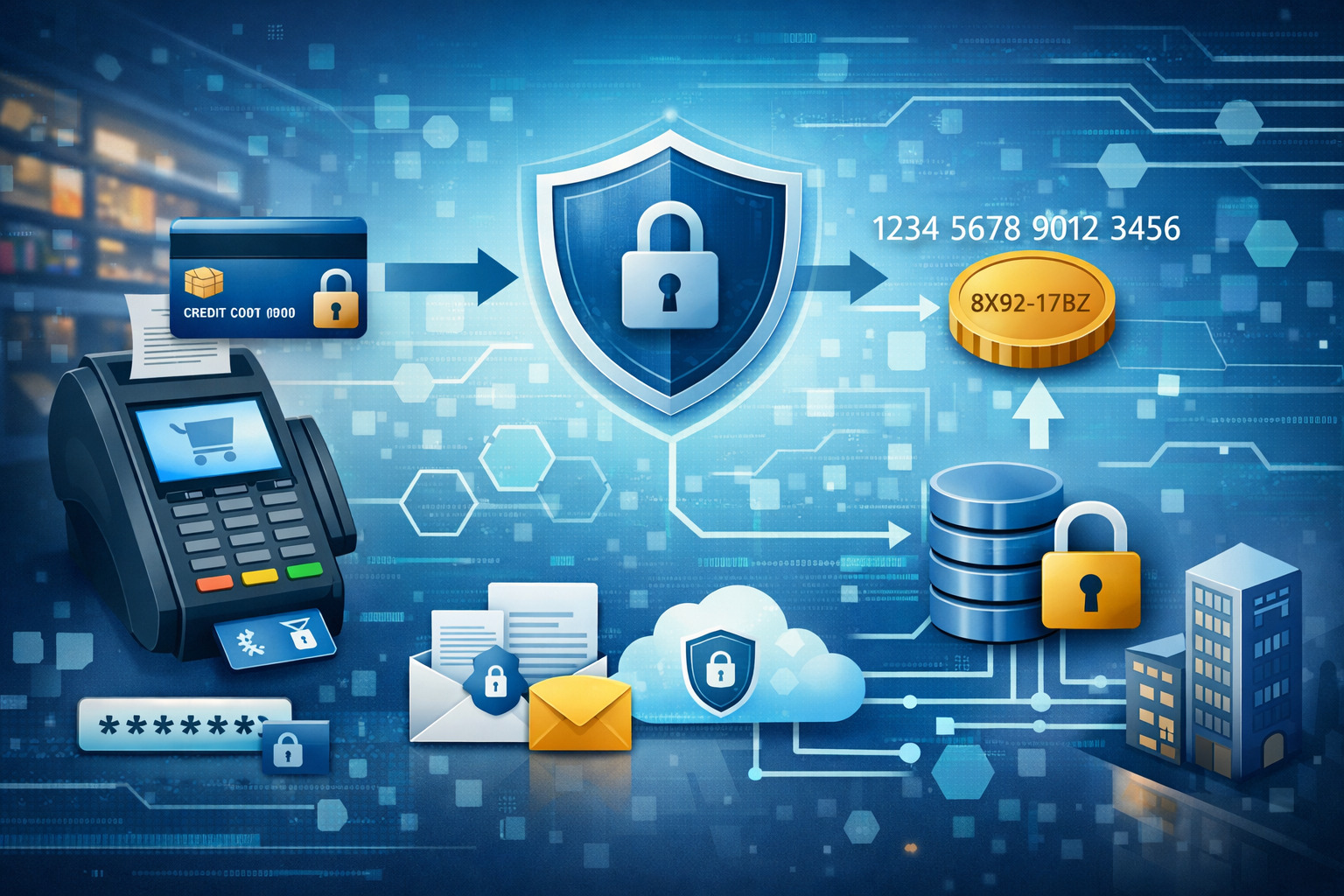
Tokenization is the second pillar of POS security architecture because it changes what your systems store and process. Instead of keeping real PAN values in business databases, the system replaces them with tokens—non-sensitive surrogates that have no exploitable value outside the tokenization platform.
This is how businesses enable recurring billing, refunds, loyalty profiles, and analytics without carrying raw payment data everywhere.
A strong POS security architecture uses tokenization to enforce data minimization. Most business processes do not require full card numbers. They require identifiers for customer profiles, transaction references, and chargeback handling.
Tokens provide that capability while reducing exposure. If attackers steal tokens from a merchant system, those tokens should be useless without access to the token vault or detokenization service.
Tokenization also improves operational flexibility. Businesses can connect POS, ecommerce, mobile checkout, and subscription billing while keeping raw payment data under tightly controlled custody.
In a cohesive POS security architecture, tokenization becomes the connective tissue that allows omnichannel operations without expanding sensitive data sprawl.
However, tokenization must be designed carefully. Token format, vault storage, detokenization permissions, and integration patterns matter. If detokenization is too easy, tokens become “security theater.”
A well-implemented POS security architecture restricts detokenization to narrow use cases, logs every detokenization request, and uses strong authentication and authorization for any system that can request it.
Vault-Based vs. Vaultless Tokenization in POS Security Architecture
In vault-based tokenization, the system stores a mapping between the token and the original card data in a secure vault. In vaultless tokenization, the token is generated in a way that can be validated or reversed only under strict cryptographic controls, often without storing a direct mapping table.
Both approaches can fit a POS security architecture, but the choice depends on risk tolerance, scale, and operational needs.
Vault-based tokenization is common because it is straightforward and supports a wide range of workflows. The vault becomes a high-value asset, so your POS security architecture must treat it like a crown jewel.
That means hardened infrastructure, strict network segmentation, controlled admin access, tamper-evident logging, and continuous monitoring. Done correctly, vault-based tokenization is highly effective, but it demands strong governance.
Vaultless tokenization can reduce certain vault-centric risks, but it requires strong cryptography and disciplined key control. If the cryptographic keys or tokenization logic are mishandled, the whole model weakens.
A mature POS security architecture evaluates vaultless approaches carefully, especially where regulatory expectations and third-party assessments apply.
In practice, many merchants consume tokenization as a service from their payment processor or gateway. That can be a smart move in POS security architecture because it centralizes the most sensitive operations in a specialized environment.
The key is understanding who owns token security, what the service-level commitments are, how detokenization is governed, and what logs and reports you can access for audits and incident response.
Designing Tokenization for Refunds, Recurring Billing, and Omnichannel POS Security Architecture
Tokenization must support real business needs, not just security goals. In a live POS security architecture, tokens power refunds without requiring full PAN retrieval, enable recurring billing for memberships, and unify customer payment methods across in-store and online experiences.
Poor token design creates operational friction that staff work around—often by storing sensitive data in unsafe places.
A reliable POS security architecture defines token lifecycle rules: when tokens are created, how they are linked to customers, how they are invalidated, and how they are migrated if you change processors.
This is crucial because token portability can become a strategic business constraint. Some token ecosystems are proprietary, meaning tokens may not be transferable across providers without re-tokenizing customers. Your architecture should plan for that reality.
Refund workflows deserve special attention. Many businesses process refunds days later, sometimes from a different store location. Tokenization should allow refunds using transaction references or customer tokens without exposing card data.
In a high-quality POS security architecture, refund permissions are role-based, logged, and monitored for anomalies such as excessive refunds, split refunds, or refunds outside policy windows.
For omnichannel operations, tokenization is how you avoid duplicating sensitive data in multiple systems. A forward-looking POS security architecture standardizes how tokens are stored and referenced across POS, ecommerce platforms, customer relationship tools, and accounting systems. That keeps integrations cleaner, audits simpler, and breach exposure dramatically lower.
Access Controls in POS Security Architecture: Least Privilege, Strong Authentication, and Accountability
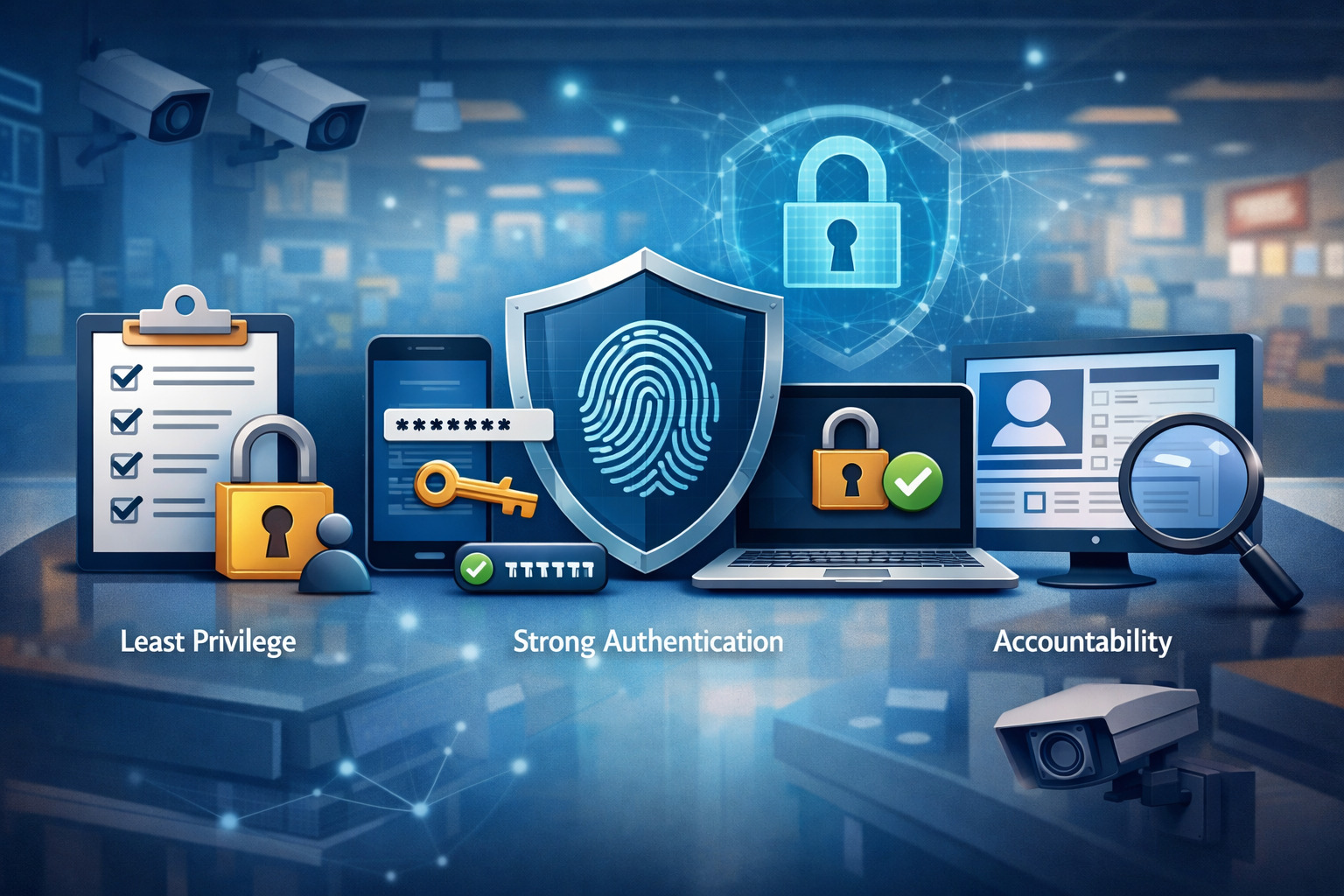
Access controls are the third pillar of POS security architecture, and they’re the most “human-dependent.” Encryption and tokenization reduce data value, but access controls reduce the chance of compromise and misuse.
In POS environments, the biggest risks often come from shared credentials, over-privileged accounts, weak remote access, and poor separation between cashier functions and administrative functions.
A mature POS security architecture enforces least privilege. Cashiers should not have device management permissions. Store managers should not have backend database access.
Third-party vendors should not have persistent admin credentials “just in case.” Every role should map to defined capabilities, and permissions should be reviewed on a schedule and on personnel changes.
Authentication must match threat reality. Password-only access is no longer sufficient for administrative actions, remote support, or access to sensitive logs and reports.
A modern POS security architecture uses multi-factor authentication (MFA) for admin portals, remote access, and any detokenization or reporting functions that could expose sensitive insights. Where feasible, it also uses device-based trust signals and conditional access policies.
Accountability is non-negotiable. Shared logins make investigations nearly impossible and increase fraud risk. A trustworthy POS security architecture requires unique user IDs, audit logging, and tamper-resistant records of key actions: refunds, voids, price overrides, configuration changes, and user provisioning events. These controls don’t just stop attackers—they reduce insider fraud and operational disputes.
Role-Based Access Control (RBAC) and Privileged Access Management in POS Security Architecture
RBAC is the workhorse model for controlling what people can do in a POS security architecture. It assigns permissions based on job function rather than on individuals, which makes operations scalable and consistent.
But RBAC must be designed carefully to avoid “role explosion” (too many roles) or “role bloat” (roles that grant too much).
A practical POS security architecture typically defines roles such as cashier, shift lead, store manager, regional manager, inventory clerk, IT support, and finance admin. Each role gets only the minimum access needed.
Cashiers may initiate sales and limited returns. Shift leads may authorize voids. Store managers may approve higher refund thresholds. Finance admins may run settlement and reconciliation reports but not alter device settings.
Privileged access management (PAM) complements RBAC for high-risk functions. In a strong POS security architecture, privileged accounts are separated from standard user accounts, protected by MFA, and used only through controlled workflows.
Sessions may be recorded, commands logged, and access granted only temporarily (“just-in-time access”) for tasks like patching, troubleshooting, or configuration changes.
For businesses using third-party POS support, PAM is one of the most effective ways to reduce vendor risk. Instead of static remote credentials, vendors request access when needed, and the business approves it within policy.
This makes POS security architecture more resilient to credential theft, vendor compromise, and shadow IT practices that quietly create permanent backdoors.
Secure Remote Access, Helpdesk Workflows, and Store Operations in POS Security Architecture
Remote access is a common breach entry point, so it deserves deep attention in POS security architecture. Many POS environments rely on remote tools for support, device management, and software updates.
If those tools are exposed, misconfigured, or protected only by weak credentials, attackers can gain administrative control without touching a payment terminal physically.
A modern POS security architecture treats remote access as a controlled system: VPN or zero-trust network access with MFA, device posture checks, limited admin privileges, and strict logging.
Remote sessions should be time-bounded and approved through a ticketing or helpdesk workflow. The goal is to align support convenience with security accountability.
Store operations add complexity. During peak hours, staff need fast overrides. That’s where architecture and policy must work together. A realistic POS security architecture uses tiered approvals, manager PINs with defined scopes, and transaction-level logging that flags unusual patterns.
For example, repeated “no receipt” refunds late at night, or repeated price overrides on high-theft items, should trigger alerts.
This is also where training becomes part of architecture. A trustworthy POS security architecture includes operational playbooks: how to validate vendor support calls, how to handle suspicious device behavior, and how to respond if a terminal shows unexpected prompts.
These aren’t just “security awareness” tips—they’re controls that reduce the chance of human error becoming a breach pathway.
Integrating Encryption, Tokenization, and Access Controls Into a Cohesive POS Security Architecture
The real power of POS security architecture comes from how the pillars reinforce each other. Encryption protects data movement. Tokenization removes sensitive data from business systems.
Access controls prevent unauthorized actions and reduce blast radius. When combined, they create layered defense: even if one control fails, the others limit damage.
A cohesive POS security architecture maps data flows end-to-end. Where does card data enter? Where is it encrypted? Where is it tokenized? Which systems ever see sensitive values? Which identities can change configurations or request detokenization?
This mapping reveals unnecessary exposure. Often, businesses discover that logs, analytics tools, or custom integrations store more sensitive data than intended.
Architecturally, the best pattern is “capture secure, process minimal, store tokenized.” That means the card reader encrypts at capture, the POS application processes without ever handling raw PAN where possible, and back-office systems store tokens and transaction references.
A mature POS security architecture also enforces network segmentation so POS devices can talk only to required payment endpoints, not to general corporate resources.
Operationally, cohesion means unified policy and monitoring. You want consistent identity management, centralized logging, and clear ownership for each component.
If encryption keys are managed by one team, token services by another, and POS user access by store operations with no governance, gaps appear. A credible POS security architecture assigns responsibilities, creates review cycles, and enforces change control for payment-impacting systems.
Finally, cohesion supports scalability. Whether you operate five terminals or five thousand, a unified POS security architecture allows you to roll out devices, rotate keys, audit access, and detect anomalies without reinventing processes per store or per vendor.
Network Segmentation and Zero-Trust Principles in POS Security Architecture
Network design is often the invisible backbone of POS security architecture. Even with strong encryption and tokenization, flat networks allow attackers to move laterally from a compromised workstation to a POS lane or from a guest Wi-Fi network to payment systems. Segmentation reduces that risk by limiting which devices can communicate and which services are reachable.
A strong POS security architecture places POS endpoints in dedicated network segments with strict firewall rules. POS devices should reach only the services they need—payment gateways, device management servers, time synchronization, and approved update repositories. Everything else should be blocked by default. This approach limits both malware spread and data exfiltration paths.
Zero-trust principles strengthen segmentation by treating every connection as untrusted until proven otherwise. In a modern POS security architecture, identity, device posture, and context determine access—not just location on the network. That’s especially relevant when stores rely on cloud-managed POS platforms, mobile devices, or hybrid networks.
Segmentation also supports compliance and incident response. During an investigation, being able to show that POS systems were isolated and that sensitive traffic was restricted can reduce the scope and severity of findings.
More importantly, segmentation can stop incidents from becoming enterprise-wide outages. In future-facing POS security architecture, segmentation and zero-trust are not optional add-ons—they’re core design expectations as attackers increasingly target multi-store environments and remote management channels.
Logging, Monitoring, and Incident Response in POS Security Architecture
You can’t protect what you can’t see, and visibility is a defining feature of a mature POS security architecture. Logging and monitoring are where architecture becomes operational confidence. Without them, encryption and tokenization might reduce exposure, but you’ll still be blind to fraud, misuse, and early signs of compromise.
A high-quality POS security architecture collects logs from POS endpoints, payment applications, admin consoles, identity providers, network controls, and tokenization services.
The focus is not just “collect everything,” but “collect what supports detection and investigation.” Key events include login attempts, privilege changes, refund activity, configuration changes, device enrollment, remote support sessions, and unusual outbound network traffic.
Monitoring should be tuned to POS reality. Stores have peaks, staffing changes, and legitimate anomalies like seasonal returns. A reliable POS security architecture uses baselines and alert thresholds designed for each business type.
For example, a restaurant might have different refund patterns than a specialty retail store. Alerting should highlight meaningful deviations, not drown teams in noise.
Incident response must be planned, not improvised. A resilient POS security architecture includes playbooks for isolating devices, rotating credentials, suspending remote access, preserving logs, and engaging forensic support.
It also includes business continuity steps—how to keep selling safely during an incident. As threats evolve, future-ready POS security architecture will increasingly rely on automated containment: disabling suspicious accounts, blocking unusual egress, and quarantining endpoints based on behavioral signals.
Compliance, Standards, and Governance That Shape POS Security Architecture
A trusted POS security architecture aligns with recognized standards and governance expectations. Compliance is not the same as security, but security programs that ignore compliance often fail audits, lose processing privileges, or face punitive contractual outcomes after incidents. The strongest approach is to use standards as guardrails while designing beyond minimum requirements.
Payment environments are commonly influenced by PCI expectations for cardholder data protection, secure networks, vulnerability management, access controls, monitoring, and incident response.
A well-structured POS security architecture treats these areas as design inputs, not end-of-year checklists. If your architecture inherently reduces card data exposure through P2PE and tokenization, compliance becomes easier and more consistent.
Governance includes policies, vendor management, and documentation. In real deployments, POS ecosystems involve multiple third parties: POS software vendors, hardware providers, integrators, payment gateways, and managed IT services.
A credible POS security architecture includes vendor due diligence, security responsibilities in contracts, and clear escalation paths for incidents.
Regulatory expectations also influence data handling beyond payment data. Customer profiles, receipts, and loyalty systems can involve personal data with privacy implications. A mature POS security architecture supports data minimization, retention limits, and secure deletion practices.
Even when payment data is tokenized, privacy and fraud risks remain. Governance is how you ensure the architecture stays secure after new stores open, new features launch, and staffing changes occur.
Aligning POS Security Architecture With PCI DSS 4.0, NIST Guidance, and Industry Best Practices
PCI DSS 4.0 has driven many organizations to modernize how they validate controls, monitor environments, and manage access.
A forward-looking POS security architecture uses PCI-aligned principles—strong authentication, least privilege, secure configurations, and continuous monitoring—while also borrowing from broader cybersecurity frameworks.
NIST guidance is widely used for risk-based security programs, and it maps well to POS realities. A practical POS security architecture aligns with identify-protect-detect-respond-recover thinking.
Identify your assets and data flows. Protect with encryption, tokenization, segmentation, and access controls. Detecting through logs and monitoring. Respond with playbooks. Recover with tested continuity procedures.
Industry best practices include secure software development, vulnerability management, and change control. POS environments often depend on vendor patches, but merchants still own deployment discipline.
A credible POS security architecture defines maintenance windows, tests updates, and tracks device versions. It also enforces secure defaults: disabling unused services, locking down ports, and preventing unauthorized app installation on POS devices.
As threat patterns change, standards increasingly expect continuous assurance rather than annual compliance snapshots. That’s why modern POS security architecture is shifting toward continuous control monitoring, stronger identity governance, and measurable risk reduction.
Businesses that treat these frameworks as living systems—not paperwork—build the kind of trust that improves approvals, reduces downtime, and supports growth.
Future Trends and Predictions for POS Security Architecture
The next phase of POS security architecture will be shaped by two forces: smarter attackers and more distributed commerce. On the attacker side, expect continued growth in credential-based attacks, AI-assisted social engineering, and supply-chain compromise targeting software updates and remote management tools.
On the commerce side, expect more mobile POS, self-checkout, unattended kiosks, and blended in-store/online journeys that push tokenization deeper into business workflows.
Future-ready POS security architecture will place stronger emphasis on identity as the new perimeter. That means more adaptive MFA, conditional access, device trust scoring, and just-in-time privilege.
Password-only admin access will increasingly be viewed as negligent for payment-adjacent systems. We’ll also see more hardware-backed security on endpoints, including secure enclaves and tamper-resistant device attestation.
Tokenization will expand beyond payments into broader “data tokenization” for sensitive identifiers, enabling analytics and personalization without exposing raw values. In POS security architecture, token orchestration across channels will become a competitive differentiator because it reduces breach risk while enabling seamless customer experiences.
Finally, automation will become the operational center of gravity. Organizations will use automated segmentation policy enforcement, continuous configuration checks, and real-time anomaly detection tied to containment actions.
The businesses that win will treat POS security architecture as a product: versioned, monitored, tested, and improved continuously—because the threat landscape won’t slow down, and neither will customer expectations.
FAQs
Q.1: What is POS security architecture, and why does it matter?
Answer: POS security architecture is the complete design of how your point-of-sale environment protects transactions, devices, users, and sensitive data. It matters because POS systems sit at the intersection of revenue and risk.
If an attacker compromises a POS endpoint, they can steal payment data, manipulate refunds, disrupt store operations, or use the POS network as a foothold into other business systems. A strong POS security architecture reduces both the likelihood of compromise and the impact of incidents.
The key idea is that security is not one feature. POS security architecture combines technical controls—like encryption, tokenization, segmentation, and monitoring—with operational controls—like role-based permissions, device inventory, patch routines, and incident playbooks. When these pieces work together, the POS environment remains resilient even under active attack.
A well-built POS security architecture also supports growth. As you add lanes, locations, and new payment methods, a consistent architecture keeps security predictable. Instead of reinventing controls per store, you scale standardized protections across the business, improving compliance outcomes and reducing operational surprises.
Q.2: How do encryption and tokenization differ in POS security architecture?
Answer: Encryption and tokenization solve different problems inside POS security architecture. Encryption transforms sensitive data into unreadable ciphertext using cryptographic keys.
It’s ideal for protecting data in transit and, when implemented properly, protecting captured card data from exposure in merchant systems. If someone intercepts encrypted data without keys, it should be useless.
Tokenization replaces sensitive data with a surrogate value called a token. Tokens are meant to be non-sensitive and unusable outside the tokenization system.
In a strong POS security architecture, tokenization is how you keep real PAN values out of business databases while still supporting refunds, recurring billing, customer profiles, and reporting.
In practical terms, encryption helps secure data movement and capture, while tokenization reduces long-term storage risk and limits how many systems can ever touch real card data. The strongest POS security architecture typically uses both: encrypt early, tokenize quickly, and strictly control any pathway that could reveal original values.
Q.3: What access controls are most important for a secure POS security architecture?
The most important access controls in POS security architecture are least privilege, MFA for administrative access, unique user accounts, and strong audit logging. Least privilege ensures users can do only what they need.
MFA reduces the risk of stolen passwords being enough to compromise systems. Unique accounts ensure accountability, which reduces insider fraud and improves investigations.
In addition, privileged access should be tightly governed. A mature POS security architecture separates admin accounts from daily user accounts, restricts remote support access, and uses just-in-time permissions for high-risk tasks.
It also monitors behavior—like unusual refunds, late-night overrides, or repeated configuration changes—to detect misuse early.
These controls are especially critical because POS environments have high staff turnover and busy workflows. A secure POS security architecture is designed for operational reality: it keeps checkout fast while ensuring the people and systems behind the counter can’t quietly expand access beyond policy.
Q.4: Do small businesses need enterprise-grade POS security architecture?
Answer: Yes—because attackers don’t target by business size, they target by opportunity. A small business with weak remote access, shared passwords, and unpatched devices can be easier to compromise than a larger brand.
The good news is you don’t need complexity to build a strong POS security architecture. You need disciplined fundamentals.
A practical small-business POS security architecture emphasizes three things: use secure payment capture methods (like P2PE-capable devices where appropriate), rely on tokenization so you don’t store sensitive payment data, and enforce basic access control hygiene with MFA and unique user logins. Add segmentation where possible and keep devices updated.
Many modern POS platforms and payment providers offer managed security features that can significantly improve posture without large internal teams. The critical requirement is to configure and operate those features consistently.
A small business that treats POS security architecture as a core operational priority can be far safer than a larger organization with sloppy controls.
Conclusion
The strongest POS security architecture is not built from slogans—it’s built from engineered controls that match real business workflows. Encryption protects data movement and capture. Tokenization removes sensitive data from day-to-day systems.
Access controls prevent misuse, limit blast radius, and make actions accountable. Together, these pillars create a POS security architecture that reduces breach impact, improves compliance readiness, and supports scalable growth.
If you want an architecture that holds up under modern threats, focus on cohesion: encrypt as early as possible, tokenize wherever storage or reuse is needed, and enforce least privilege with MFA and logging.
Add segmentation, monitoring, and incident playbooks so you can contain issues quickly. Most importantly, treat POS security architecture as a living program. Devices change, staff changes, vendors change, and attackers change. Your controls must evolve too.
A business that invests in a modern POS security architecture earns something more valuable than compliance. It earns operational confidence: the ability to take payments securely, expand locations, integrate new channels, and protect customers—without gambling the business on fragile checkout technology.