
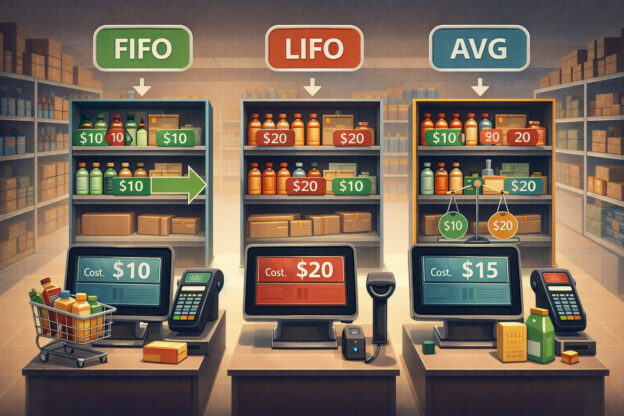
Modern retailers don’t lose money only from slow sales—they lose it from bad inventory math. A POS can ring up transactions perfectly and still produce misleading profit reports if your POS inventory models aren’t aligned with how costs actually flow through your shelves, stockroom, and supply chain.
Inventory costing affects far more than “accounting.” It shapes pricing strategy, margin visibility, shrink detection, vendor negotiations, reorder points, and even how confidently you can expand to a second location.
When costs rise (which they often do), the choice between FIFO, LIFO, and weighted average can materially change your Cost of Goods Sold (COGS), taxable income, and inventory asset values—sometimes enough to influence lending decisions and investor reporting.
This guide breaks down the three primary POS inventory models used for inventory valuation—FIFO, LIFO, and weighted average—with detailed operational examples and practical implementation advice for retail, eCommerce, and omnichannel businesses.
It also covers compliance considerations tied to financial reporting and tax elections, including the IRS LIFO election process and the accounting rules that govern inventory measurement.
What “POS Inventory Models” Really Mean (And Why They Matter Beyond Accounting)

When people say “POS inventory models,” they usually mean the cost flow assumption your POS uses to assign dollar costs to items sold and items still on hand. The key phrase is assumption.
Your POS is not literally tracking which physical unit left the shelf first (unless you use serialization or lot tracking). Instead, it applies a consistent rule to convert inventory movement into financial values: COGS and ending inventory.
Why does this matter? Because every sales report that shows profit is built on COGS. If COGS is overstated, profits look smaller; if understated, profits look bigger. That affects pricing decisions, promotional strategy, and how you evaluate staff performance. It also changes the story your financial statements tell—especially when prices fluctuate.
In real operations, your POS inventory models must also align with how you manage replenishment. If you sell perishable goods, FIFO usually matches operational reality. If you sell commodities with rising costs, LIFO can reduce taxable income (where permitted) but can also make inventory values look “older” on the balance sheet.
If you sell high-volume interchangeable units (like hardware, apparel basics, supplements, or standard electronics accessories), weighted average can smooth volatility and simplify reconciliations.
The best model is not “the one that makes profits look best.” The best model is the one that produces reliable, auditable, decision-useful numbers—and can be executed consistently across your POS, purchasing, receiving, and accounting workflows.
The Core Inventory Valuation Goal Inside Any POS
Every POS inventory system is trying to answer two financially critical questions:
- What did the goods we sold cost us? (COGS for the period)
- What is the cost of the goods still in stock? (ending inventory asset)
Those two numbers drive gross margin, net income, and inventory valuation on financial statements. Most POS platforms calculate this from three data sources:
- Beginning inventory value
- Purchases/receipts (including landed costs if you track them)
- Units sold (and returns)
This is where POS inventory models become the engine. FIFO, LIFO, and weighted average determine how receipts are assigned to sales.
It’s also where operational discipline becomes non-negotiable. If your receiving is late, if staff “ghost receive” items, if transfers are not posted, or if returns are processed incorrectly, your model—no matter how accurate in theory—becomes inaccurate in practice. A model is only as good as the transaction integrity behind it.
Finally, inventory isn’t just valued at “cost forever.” Accounting guidance requires ongoing evaluation for impairment or lower-of rules, depending on the method used—especially when goods become obsolete, damaged, or unsellable.
Under U.S. GAAP, inventory measured using FIFO or average cost is generally subject to a “lower of cost and net realizable value” approach (with specific guidance in ASC Topic 330).
FIFO in POS Inventory Models: How It Works, Why It’s Popular, and Where It Can Mislead
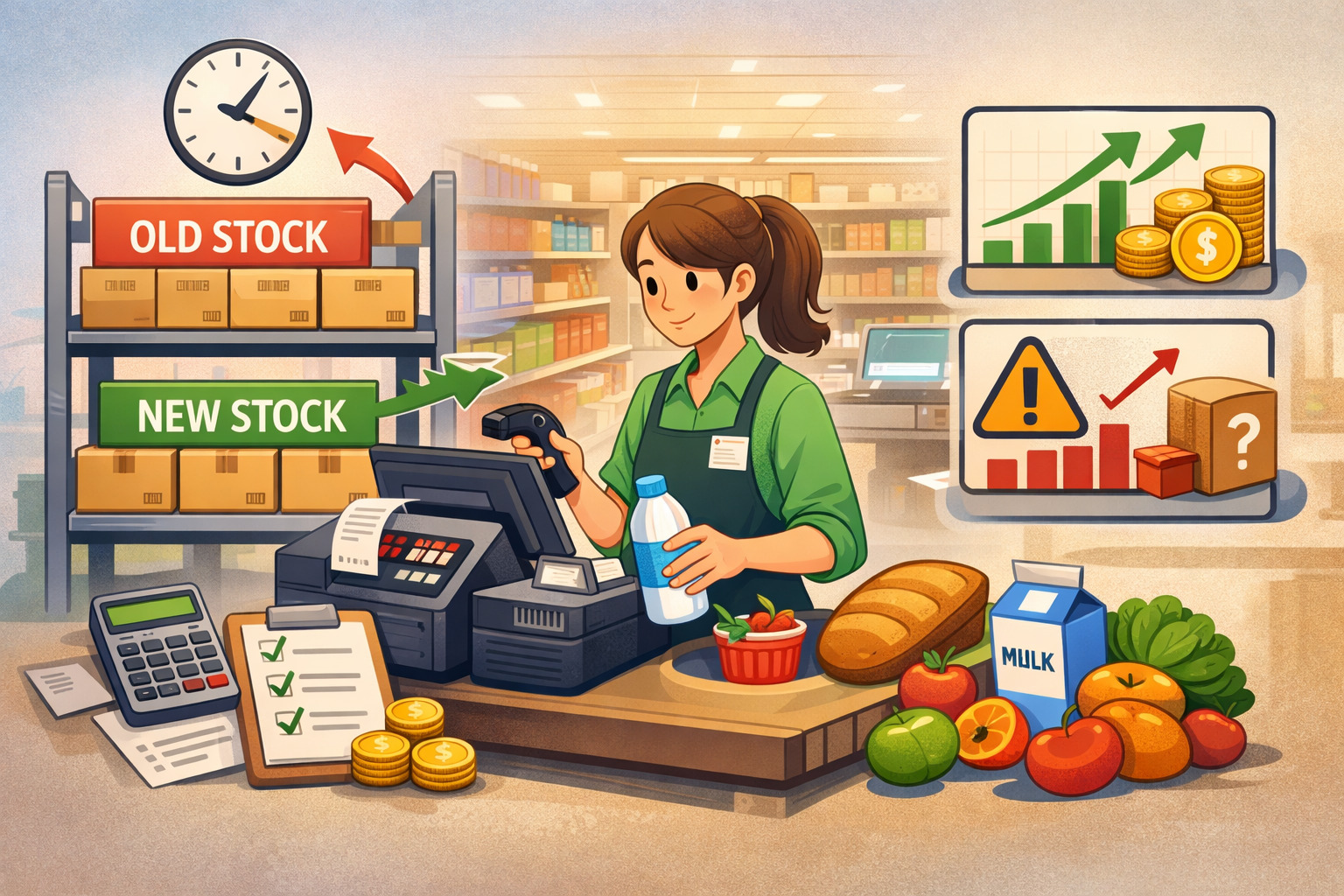
FIFO (First-In, First-Out) assumes the first units you purchased are the first units you sell. In POS inventory models, FIFO typically means your POS assigns the oldest recorded unit costs to COGS first.
For many businesses, FIFO aligns with real-world stock rotation: older inventory gets sold before newer inventory to reduce spoilage, obsolescence, and markdown exposure.
How FIFO Impacts Profit Reporting
In periods of rising costs, FIFO pushes older, cheaper costs into COGS first. That usually produces:
- Lower COGS (initially)
- Higher gross profit
- Higher taxable income (all else equal)
- Higher ending inventory values (since remaining units are newer and more expensive)
For retail owners, that “higher margin” can feel great—until you realize the margin is partially a timing effect. FIFO can make profits look stronger even though replacing inventory costs more now.
If you’re using FIFO results to decide how deep to discount, how aggressively to expand, or how much cash you can safely distribute, you must also monitor replacement cost and cash flow.
Real-World FIFO Example (Retail)
A convenience retailer buys 100 units of a beverage at $1.00, then later buys 100 units at $1.30. If they sell 120 units:
- FIFO COGS: 100×$1.00 + 20×$1.30 = $126
- Ending inventory: 80×$1.30 = $104
This can support clearer “fresh inventory value” on the balance sheet, which lenders often like. But it can overstate current profitability if costs are rising rapidly.
Where FIFO Fits Best
FIFO works well for:
- Grocery, beverage, supplements, cosmetics
- Electronics with fast refresh cycles
- Fashion where old stock becomes markdown risk
- Any business that uses expiration dates or batch rotation
In short, FIFO is often the most intuitive of the POS inventory models—simple to explain, operationally aligned, and widely used.
LIFO in POS Inventory Models: Benefits, Tradeoffs, and Compliance Reality

LIFO (Last-In, First-Out) assumes the newest units purchased are sold first. In POS inventory models, that means your POS assigns the most recent costs to COGS first and leaves older costs in ending inventory.
LIFO is most famous for one reason: in inflationary periods, LIFO often produces higher COGS and therefore lower taxable income, improving after-tax cash flow. That’s why some high-inventory businesses consider it—especially those with significant commodity exposure.
LIFO’s Financial Statement Effects
When purchase costs rise, LIFO typically produces:
- Higher COGS
- Lower gross profit (on paper)
- Lower taxable income (potentially)
- Lower ending inventory values (since remaining layers may be old)
But LIFO can also create reporting complexity. Over time, inventory on the balance sheet can reflect older prices that are far from today’s replacement costs. That can reduce comparability and make inventory ratios less intuitive.
Tax Election and Governing Rules
Using LIFO for tax reporting isn’t just a POS setting—it is a regulated method. Businesses electing LIFO for federal income tax typically file IRS Form 970 tied to Internal Revenue Code Section 472.
Changing accounting methods can also require formal procedures and approvals, which is why LIFO should be discussed with a qualified tax professional before implementation.
Operational Challenges Inside a POS
Many POS platforms do not support true LIFO “layer accounting” the way larger ERP systems do. Even when a POS offers LIFO, you must validate:
- How it handles returns
- How it handles transfers between locations
- How it handles negative inventory events
- Whether it supports LIFO pools and indexes if needed
If your POS can’t maintain consistent layers, your LIFO reports may be difficult to defend in a tax or financial statement context.
Global Reporting Note
International standards generally do not allow LIFO as an inventory cost formula (IAS 2). That matters for businesses reporting under IFRS-based frameworks or operating in multi-jurisdiction environments.
Weighted Average in POS Inventory Models: The “Smoothing” Method That Simplifies Operations
Weighted Average Cost (often called AVCO or WAC) calculates an average unit cost across available inventory and assigns that average cost to units sold and units remaining. In POS inventory models, weighted average is widely used because it reduces volatility and is easier to maintain than layer-based methods.
How Weighted Average Works in Practice
At a basic level, weighted average cost per unit equals:
(Total cost of goods available for sale) ÷ (Total units available for sale)
Your POS then applies that per-unit cost to sales and inventory counts. Some systems calculate average cost periodically (periodic system), while others recalculate after each receipt (perpetual moving average). The distinction matters, especially when you have frequent receiving.
Why Retailers Like Weighted Average
Weighted average is ideal when:
- Units are interchangeable
- Purchase costs fluctuate often
- You want stable margins for decision-making
- You want simpler audits and reconciliations
Example: A hardware retailer buys identical screws at different prices across the year. FIFO might cause margins to swing depending on which purchase batch is “next.” Weighted average produces a steady, explainable margin trend—useful for pricing, promotions, and manager performance tracking.
Limitations You Must Plan For
Weighted averages can hide useful signals. If supplier costs spike, weighted average may delay how quickly higher costs show up in COGS. That can cause pricing decisions to lag behind real replacement costs—especially for fast-moving SKUs.
To manage this, strong businesses pair weighted average with:
- Vendor cost monitoring
- Reorder cost alerts
- Price rule automation
- Margin guardrails by category
As POS inventory models go, weighted average is often the most operationally forgiving—provided you actively monitor cost trends so you don’t get surprised at reorder time.
FIFO vs LIFO vs Weighted Average in POS Systems: Decision Factors That Actually Matter
Choosing among POS inventory models should be a structured decision, not a guess. These are the factors that most consistently drive the right selection:
1) Your Product Behavior: Perishable, Obsolete, or Interchangeable
- Perishable or expiring goods: FIFO aligns with stock rotation.
- Tech, fashion, seasonal goods: FIFO supports realistic clearance planning.
- High-volume interchangeable SKUs: weighted average simplifies and stabilizes.
- Commodity-driven inventory: LIFO can be attractive for tax reasons where permitted.
2) Margin Volatility and Pricing Strategy
If you rely on stable margin reporting to manage pricing, weighted average can provide cleaner signals. If you need a balance sheet closer to current costs, FIFO generally keeps ending inventory nearer to recent purchases.
3) Tax and Reporting Goals
LIFO’s tax advantage is the main driver, but it comes with compliance considerations and can reduce reported earnings. It may also be incompatible with certain reporting requirements outside U.S. GAAP contexts.
4) POS Capability and Integration
A model that is “best” in theory is a bad choice if your POS can’t execute it consistently across:
- multi-location transfers
- bundles/kits
- returns/exchanges
- partial receiving
- landed cost allocation
5) Auditability and Internal Controls
For any model, you need clean audit trails: receiving logs, vendor bills, inventory adjustments, cycle counts, and reason codes for shrink. Weak controls make every model unreliable, but they can be especially painful under more complex approaches.
A practical rule: if your team struggles with clean receiving and frequent cycle counts, weighted average or FIFO often produces more dependable reporting than a poorly maintained LIFO setup.
How POS Inventory Models Affect COGS, Taxes, Cash Flow, and Lending Metrics
Inventory valuation isn’t just “an accounting report.” Your POS inventory models directly influence how outsiders view your business.
COGS and Gross Margin
- FIFO (rising costs): lower COGS → higher margin
- LIFO (rising costs): higher COGS → lower margin
- Weighted average: moderated COGS → smoother margin
Taxable Income and Cash Flow
Tax isn’t the same as cash flow, but taxable income affects cash you must send out. LIFO can reduce taxable income in inflationary cycles, improving cash retention—one reason businesses elect it through IRS Form 970 where appropriate.
Inventory Asset Value and Loan Covenants
Lenders often examine:
- inventory turnover
- current ratio
- working capital
- borrowing base (in asset-based lending)
FIFO generally reports higher inventory values in rising-cost environments, which can strengthen these ratios. LIFO may reduce inventory values, which can impact certain covenants or borrowing calculations.
Managerial Decisions
The most dangerous outcome is using the wrong model’s profit signal to make operational decisions:
- setting discounts too deep
- underpricing fast sellers
- over-ordering based on inflated margins
- thinking shrink is “fine” because margins appear healthy
Strong operators use POS inventory models for financial consistency and pair them with operational analytics (sell-through, aging, shrink, replenishment lead time) for real-world control.
Implementation in a POS: Setup, Data Hygiene, and Workflow Design
A costing method doesn’t succeed because you clicked the right setting. It succeeds because your workflows protect data quality.
Receiving Discipline Is the Foundation
To make POS inventory models reliable, receiving must be accurate:
- match quantities to packing slips
- validate SKU accuracy (barcode scan, not manual typing)
- post receipts promptly
- capture vendor cost changes consistently
If costs are entered late or inconsistently, FIFO layers, LIFO layers, and weighted averages all become distorted.
Returns and Exchanges Must Preserve Cost Integrity
Returns can be tricky:
- Did the POS return the item to stock at its original cost?
- Did it create an adjustment?
- Did it treat it as a new receipt?
Your method must be consistent, and your staff must follow one returns path—not multiple “creative” workflows depending on the cashier.
Multi-Location Transfers
Transfers should include:
- cost basis movement (not just quantity)
- in-transit tracking where possible
- receiving confirmation at the destination location
Transfers done as “adjust out here, adjust in there” can break your costing model and create phantom margin swings.
Cycle Counts and Shrink Controls
A POS that never gets counted is eventually wrong. Strong operators use:
- ABC counting (A items weekly, B monthly, C quarterly)
- reason codes for adjustments
- manager approval thresholds
- shrink dashboards by category and location
This is how you keep POS inventory models aligned with physical reality, not just theory.
Industry-Specific Examples: Which POS Inventory Models Fit Which Businesses
Grocery, Specialty Food, and Health Products
FIFO is usually the operational match because goods expire and freshness matters. FIFO also improves the usefulness of your on-hand valuation because it reflects more recent purchases. Weighted average can work for bulk commodities (like packaged staples), but FIFO often helps prevent selling outdated inventory.
Apparel, Footwear, and Seasonal Retail
FIFO supports inventory aging analysis and markdown strategy because older receipts are costed out first, leaving newer inventory valued at newer costs. Weighted average can smooth margin reporting for basics, but FIFO is typically better for seasonal lines.
Electronics Accessories and Commodity Goods
The weighted average often wins. Costs can change frequently, and units are interchangeable. Weighted average reduces the “margin whiplash” that FIFO can create when costs jump.
High-Inventory, Inflation-Sensitive Businesses
LIFO may be considered where tax strategy is a priority and compliance capacity is strong. But many businesses still use FIFO or weighted average in the POS operationally and handle LIFO at the accounting layer—depending on system capability and reporting needs. IRS election requirements apply if LIFO is adopted for tax.
Compliance and Standards: What Governing Bodies Expect You to Know
Inventory accounting lives inside a framework of standards and rules. Even if you’re not publicly traded, your bank, CPA, or investors may expect you to follow these norms.
U.S. GAAP and Inventory Measurement (ASC Topic 330)
Financial reporting guidance under U.S. GAAP addresses inventory costing and subsequent measurement, including how inventory is evaluated when its value declines (for example, due to damage or obsolescence).
Accounting guidance distinguishes between LIFO/retail methods and other methods such as FIFO or average cost for certain measurement approaches.
Tax Rules and LIFO Election (IRS Form 970)
LIFO is not simply a preference—it is a regulated election for tax purposes, generally requiring filing Form 970 with the return for the first year LIFO is used, referencing the Internal Revenue Code’s LIFO provisions.
IFRS Considerations (IAS 2)
If you operate across reporting regimes or deal with stakeholders using international standards, note that IAS 2 does not permit LIFO as a cost formula. This can affect comparability for multinational reporting contexts.
Common Mistakes That Break FIFO, LIFO, and Weighted Average in Real POS Environments
Even the “right” method fails if execution is sloppy. These mistakes repeatedly cause inaccurate COGS and inventory:
Negative Inventory Events
Selling items before receiving them (or overselling due to sync delays) can force the POS to assign costs incorrectly or create retroactive cost changes. This is especially damaging under FIFO/LIFO because layers get distorted.
Inconsistent Landed Cost Handling
If you sometimes include freight, duty, or vendor fees in item cost and sometimes don’t, your margins become noisy. Decide whether landed costs are included and apply consistently, ideally with documented rules.
Manual Price Overrides vs Cost Integrity
Cashiers overriding prices is not inherently bad—but if overrides hide cost increases, you can keep selling at unprofitable margins. A strong POS policy ties price override permissions to margin thresholds.
Uncontrolled Adjustments
Inventory adjustments should require reason codes and approvals. Otherwise, shrink becomes “miscellaneous,” and your POS inventory models become guesswork.
Poor SKU Governance
Duplicate SKUs, missing UPCs, mismatched units of measure, and inconsistent variants cause costing errors that look like “accounting issues” but are actually master-data failures.
The fix is boring but effective: governance, training, approval workflows, and frequent cycle counting.
Future Predictions: Where POS Inventory Models Are Headed Next
Inventory valuation is becoming more automated, more real-time, and more predictive. Here’s what’s likely to matter most going forward:
1) Real-Time Moving Average and Event-Driven Costing
More POS platforms are shifting toward perpetual inventory and moving average logic because it scales well with omnichannel selling. As systems improve, weighted average (especially moving average) will become even more common for multi-channel operations.
2) Smarter Cost Inputs Through Integration
Costs will increasingly flow automatically from purchase orders, EDI invoices, and supplier portals—reducing manual cost errors. When cost capture improves, FIFO and weighted average become more accurate and easier to defend.
3) AI-Driven Margin Protection
Expect more POS tools to detect:
- margin compression by SKU
- vendor cost creep
- promotional pricing that dips below acceptable margin floors
That won’t replace POS inventory models, but it will reduce the damage of delayed pricing responses when costs shift.
4) Better Traceability (Lots, Expiration, Serialization)
As regulations and consumer expectations rise for traceability in food, health, and regulated categories, POS systems will rely more on lot and expiration tracking. FIFO operational discipline will become more tightly tied to compliance and quality assurance.
5) Greater Audit Expectations for Fast-Growth Retail
Banks and investors increasingly expect strong inventory controls. That means your costing method choice will be evaluated alongside your internal controls—cycle counts, approval trails, variance reporting—not just which option you picked.
FAQs
Q1) Which POS inventory model is best for most small retailers?
Answer: For many small retailers, FIFO or weighted average is the most practical. FIFO is intuitive and aligns with stock rotation, while weighted average stabilizes margins and simplifies operations.
The best choice depends on how often your costs change, how interchangeable your units are, and how disciplined your receiving and counting processes are. If your team is still building inventory hygiene, weighted average often produces fewer “surprise” corrections than complex layer-based approaches.
Q2) Can I switch from FIFO to weighted average (or vice versa) in my POS?
Answer: Technically, many POS platforms allow changes, but switching methods can create reporting discontinuities. You must plan the cutover carefully, document the change, and reconcile inventory valuation at the transition point.
If you use external financial statements, your CPA may need disclosures or adjustments. If the change affects tax reporting methods, formal procedures may apply depending on your situation.
Q3) Does LIFO always reduce taxes?
Answer: Not always. LIFO tends to reduce taxable income when costs are rising, but if costs fall, the effect can reverse. Also, LIFO requires a valid tax election process (typically involving IRS Form 970) and consistent application.
Q4) Why do some systems use weighted average instead of FIFO by default?
Answer: Weighted average is often the easiest to maintain accurately in a high-transaction POS environment. It reduces margin volatility, handles frequent receipts cleanly, and is less sensitive to minor receiving timing issues than FIFO/LIFO layering. For multi-channel selling with frequent returns and exchanges, weighted average can be operationally forgiving.
Q5) If I’m doing FIFO, do I still need cycle counts?
Answer: Yes. FIFO is a cost flow assumption, not a physical guarantee. Inventory accuracy still depends on correct receiving, transfer posting, shrink controls, and counts. Without cycle counts, your POS inventory models will drift away from reality and produce misleading COGS and margin numbers.
Q6) Is LIFO allowed under international standards?
Answer: International standards generally do not permit LIFO as an inventory cost formula (IAS 2). That matters if you have reporting stakeholders using IFRS-based frameworks.
Conclusion
FIFO, LIFO, and weighted average are not just accounting preferences—they are business decision frameworks embedded into your POS. The “right” choice depends on your products, cost volatility, reporting needs, tax strategy, and—most importantly—your ability to execute consistent receiving and inventory controls.
- FIFO is often the most intuitive and operationally aligned, especially for perishable or aging-sensitive inventory.
- LIFO can offer tax advantages in rising-cost environments but requires stronger compliance capability and may not fit all reporting contexts, including frameworks where LIFO isn’t allowed.
- Weighted average is frequently the most stable and scalable for high-volume interchangeable items and omnichannel operations.
If you want POS inventory models that support growth, focus on two priorities: choose the method that matches your operational reality, and build the discipline (receiving, transfers, cycle counts, approvals) that keeps your data trustworthy.
When your inventory numbers are reliable, pricing gets smarter, shrink becomes visible, cash flow improves, and expansion becomes a decision you can make with confidence—not hope.